

Project Overview
Empathyz is a mobile application that helps adults navigate their adult ADHD diagnosis, understand their symptoms, and build self-empathy through meaningful educational games.
Project Skills
User Interface, User Experience, Branding, Prototyping
My Role
UX Designer
Team
Lo Cianflone, Akshay Rawat, Kaitlyn Zhang, Seth Roth
Advisor


Overview
Our inital question was: "How can a tool support university students with ADHD?",
Problem
How can we support adults as they navigate an ADHD diagnosis, mental health, relationships, and environment?
Of adults diagnosed with ADHD, less than 50% are effectively treated with medication alone. (Wilens, Spencer, & Biederman, 2000). In seeking a diagnosis, adults with ADHD often describe symptoms that are more identifiable with depression and anxiety. (Sherman 2005). These “secondary subclinical ADHD symptoms” often interfere with treatment progress, and are the result of growing up with untreated ADHD. (Kubik 2010)
Design Solution
We created Empathyz, a mobile application to provide a guide to support recently diagnosed adults as they navigated these 'secondary subclinical ADHD symptoms,' and in particular to focus on building self-empathy for their own experience.
Through “modules” developed from ADHD Coaching methods and Cognitive Behavioral Therapy (CBT), users can learn to manage these symptoms over time.
Key Features
Empathyz is designed to help users better understand themselves through daily lessons. Below are some of the key features to support users on their journey.
Lessons Are Customized
After taking an introductory quiz to assess their experience and goals, users are given a customized lesson plan recommendation.

Clinically-Based Lessons Are Bite-Sized
Each module is broken down into bite-sized lessons to reduce information overload. Additionally, users are able to engage with the lesson in multiple ways. They can listen to a recording or read a transcript of the information. Afterward, they're asked to take a short learning quiz to see how they did.

Helps Users Build Habits
People with ADHD benefit from habit stacking as a way to increase the chance of a habit sticking for the long term. For this project, we focused on creating a scheduling feature that used this principle.

Research
When creating Empathyz, we needed to learn more about our users’ everyday experiences with ADHD and their pain points. We used several observation methods:

Literature Review
Readings were prioritized based on their relation to adult diagnosis and
non-pharmacological and behavioral methods of treatment.

Screener Survey
The survey was sent out to online communities including university Reddit channels and Facebook groups for adults with ADHD.
We received 30+ responses.

Semi-Structured Interviews
We conducted 45-minute interviews
via Zoom with 9 participants. Questions were open-ended to elicit far-ranging responses.

Diary Study
Participants recorded 9 entries over
a 12 hour period anytime they felt their ADHD symptoms were impairing
their ability to work.
Affinity Mapping was conducted to find patterns across participant interviews. Each interview participant was given a different color to identify patterns visually.

Findings
We interpreted our data and identified insights on our
user's needs, values and touchpoints
Adult Diagnosis is common
More than half of university students interviewed had been diagnosed with ADHD in the past 2 years while in college (i.e. recently and not as a child)
Emotional Regulation was a common problem
A majority had problems with emotional regulation or negative self-talk relating to self-perceptions like school performance or self-worth.
Undiagnosed ADHD leads to negative self-perceptions
Undiagnosed ADHD often leads to actions like procrastination, forgetfulness, or inability to finish projects which often leads to negative self- perceptions (e.g. "I'm lazy", "I'm a failure", etc.)
Majority had limited access to therapy
A majority were not seeing a therapist due to cost, waitlists, or issues with scheduling; Cognitive Behavioral Therapy (CBT) was found to be effective in treating ADHD symptoms
ADHD Coaching is an effective treatment for symptoms
Medication is not enough for 50% of adults with ADHD - education about ADHD symptoms and increased self-understanding though ADHD coaching were empirically found to be effective in relieving symptoms.
Defining Users
After synthesizing our research findings, we’ve created two user personas to embody the potential audience that our team could design for.


Defining Design Goals
Through the insights from our user research, we’ve identified 4 design goals that informed our design solution path.

Diagrams from Atomic Habits: Tiny Changes, Remarkable Results by James Clear
Developing Potential Solutions
The team ranked pain points on 3 factors, and then developed "How Might We" questions based on the research findings. The questions were grouped into solution topics.
Ranking Pain Points
Pain points identified in research were ranked by a combination of 3 factors:
-
How many participants were experiencing an issue
-
If the team was inspired by the problem
-
The feasibility of the potential solution
_JPG.jpg)
Solution Topics Included
-
Helping students achieve goals & reduce procrastination
-
Connecting students with ADHD
-
Helping students with ADHD better understand themselves

Sketches
With our personas and design principles in mind, our team brainstormed multiple ideas through sketching. We categorized the sketches into common themes; Empathy Related, Productivity Tools, and Building Connections
After evaluating all the sketches, the team came to a consensus that our design solution should be a game to help build self-empathy.

Information Architecture
We developed an information flow to understand how a user would navigate through the structure of the product.
User Story: As a University student recently diagnosed with ADHD, I want to build a strong self-awareness, so I can understand how ADHD affects me.

User Testing
We presented a mid-fidelity prototype to 8 users and asked them to walk through the app. We used a "think aloud" method to gauge how users were thinking about the app.
The results informed our final design.


Refining The Design Solution
From usability tests, we learned we needed to shorten text blocks, divide up information into small sections, and add more visuals to differentiate between lessons.
Users want to read and listen at the
same time
Users constantly navigated back to the transcript when listening to the audio lesson. Additionally, most users felt the audio was too slow.
How We Fixed It:
Combined the audio and transcript into a single page with the ability to adjust speed.


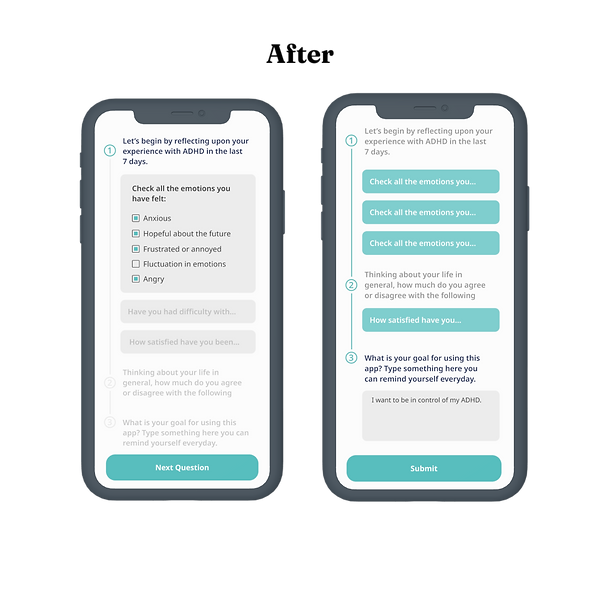
Intake Quiz is overwhelming
Users found the Intake Quiz page to be overwhelming with content. Additionally, the page was too long causing user fatigue.
How We Fixed It:
Reduced the number of questions and answer options. Collapsed questions that have been answered to reduce excessive scrolling
Users struggled to tell when lessons
were done
Users found it difficult to differentiate between lessons that have been completed vs. not started yet.
How We Fixed It:
We added a circular progress bar to indicate user progress on a lesson. The icons for the lessons that have not been completed yet are greyed out.



Final Prototype
Final Prototype
So how does it work?
First-time users are taken through an intake quiz that personalized the lessons they'll see first. Users then work through the quiz game-style lessons, while also building consistent habits and mindfulness.
Try out the prototype!
So how does it work?
First-time users are taken through an intake quiz that personalized the lessons they'll see first. Users then work through the quiz game-style lessons, while also building consistent habits and mindfulness.
Next Steps
-
Expand the game model by designing a variety of games
-
Share results of the project with interview participants
-
Include an avatar creation feature that would allow users to represent themselves in the game
Try out the prototype!
Design System
Lastly, we developed a design system to improve the design and development workflow and iterate more rapidly on the project moving forward.
Colors

Typography

Nav Bar Icons


Graphics
From Friday Illustrations by Craftwork

Buttons
